
Mixed Media and Materials in Alina Tenser’s Contemporary Art
Sculptor and professor Alina Tenser is named a 2026 Guggenheim Fellow in recognition of their innovative and minimalist approach to art and performance.
For millennia, sculptures were made of stone or clay to create organic shapes with soft lines. Sculptor Alina Tenser uses contemporary materials in her mixed media pieces that blend sharp edges with surprising gentleness.
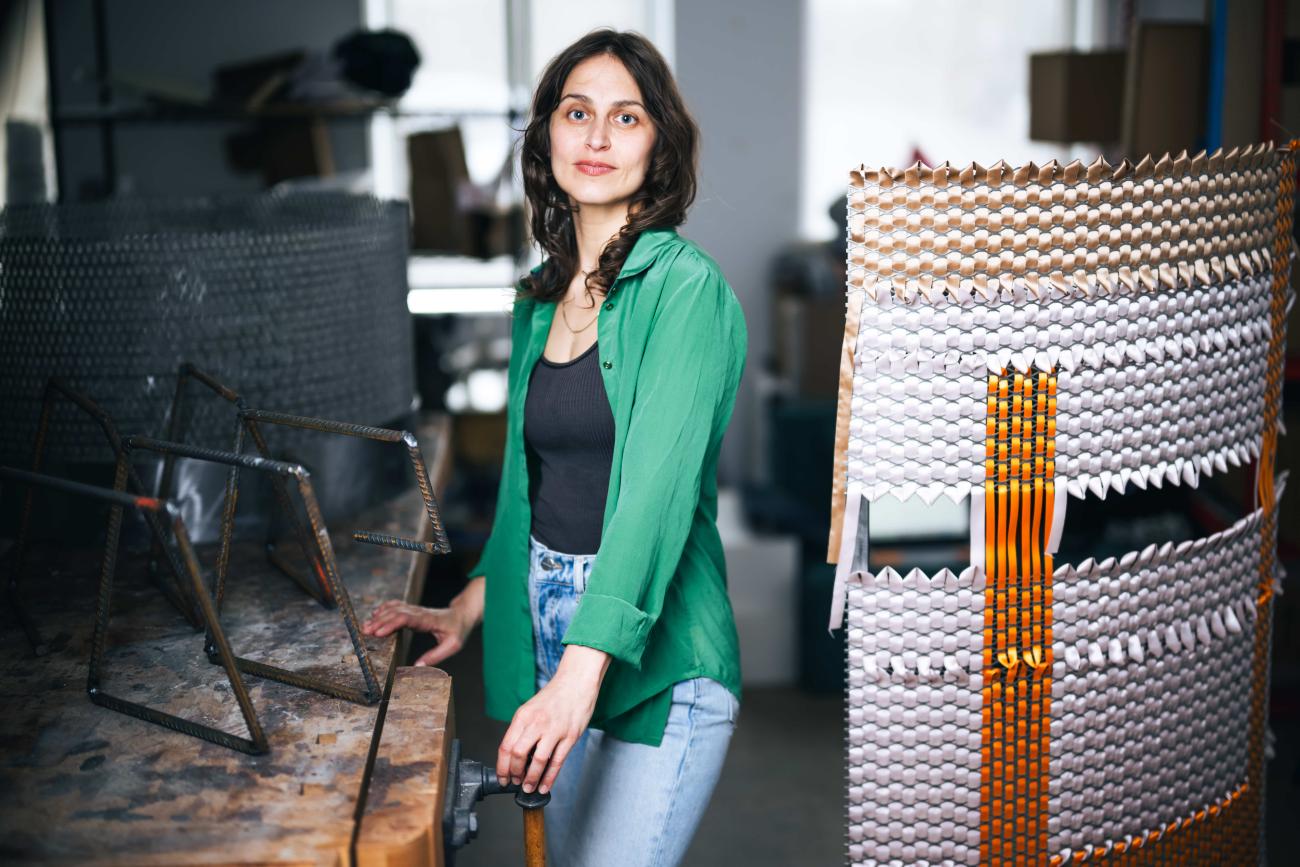
A contemporary artist and assistant professor of art in the Department of Art, Architecture and Design, Tenser creates art with things that can be found in buildings and homes from metal to fabric.
These materials can be divided into two categories, she notes, with domestic materials like vinyl, zippers, and ribbon being considered more feminine while industrial materials, like steel and concrete, are more masculine. “Some of [my work] is to play with gendered materials and processes and, in a sense, create a singular form that is really straddling both,” she says.
Roots of Practice
Born in Kyiv, Ukraine, Tenser and her family immigrated to the states when she was nine. “There's something about these austere materials like concrete and steel that was such an important part of the aesthetic of my early childhood, as well as the experience of coming to the US and becoming aware of this deep consumerist desire for materials,” she says.
Tenser recalls growing up in the Soviet Union and always wearing ribbons in her hair—a direct contrast to the severe school uniforms. She wove delicate ribbons into steel mesh in her ongoing series “Corridors.”
“They're cantilevered from the wall and shown across from each other. They're meant to be these portals,” she explains. Their artwork bridges the past and the present, offering a doorway from Soviet Ukraine to a war-torn country.
“I think, like many people, I was surprised by the full scale invasion, even though obviously it was clear that the tensions between Russia and Ukraine were deepening,” she says. The apartment Tenser grew up in was destroyed last fall and she laments the memories that are destroyed with it. “I was thinking about safe corridors and the fact that [the sculptures] use architectural language to describe something that's really invisible.”
Her current use of metal and concrete is directly related not only to the war in Ukraine, but wars around the world. Tenser’s earlier artwork used warmer materials like wood and plaster, but for her it no longer feels like it meets the current state of the world.
“I think I work with things that feel current,” she says, noting that she doesn’t love plastic but using vinyl and steel resonates right now.
Beyond Form
Many of Tenser’s early works were available for audience interaction, but she has since moved away from that participatory aspect since the COVID-19 pandemic.
Her current sculptures are static but a viewer can easily imagine their movement. Her vinyl pieces are human scale that can be zipped or unzipped, hinting at their tactical nature. “How bodies move is always implicated in my objects, even though they can be read as being minimalist,” she says.
Tenser is an artist whose work not only includes sculpture but spans video and performance. “I'm predominantly a sculptor, but video and performance are very important aspects of my work in which I can continue to investigate form outside of the boundaries of the three-dimensional space,” she explains.
“Performance allows me to activate the objects that I make or think about how objects move,” she says.
Her exhibition “Circuit Meander,” at the SEPTEMBER Gallery in Kinderhook, NY through April of this year, is an example of how sculpture and video performance inform one another. On the floor of the gallery is a sculpture constructed of interlocking, repeating geometric forms that create a circle. Behind the sculpture, a video “Walking in Circles with Sharp Corners” is projected onto the wall. The video shows an aerial view of her feet walking in a square shallow steel tray slowly filling with water. In both, she notes, “it's like these geometric shapes turning corner after corner, then make up a circular shape; it is the repetition that transforms hard edges into a circle.”
Recent Recognition
Tenser has been named a 2026 Guggenheim Fellow, a prestigious honor recognizing artists and scholars across the creative arts, humanities, and sciences who have demonstrated extraordinary achievement. Awarded annually by the John Simon Guggenheim Memorial Foundation, this competitive fellowship places Tenser within the foundation's 101st class of Fellows.
For Tenser, this fellowship comes at an opportune time as her son enters his senior year of high school and gains independence. It’s a dream for her to have the opportunity to focus exclusively on her practice for a full year.
Throughout her career, motherhood and professional practice have always been intertwined. “I've never experienced having a practice without the struggle of juggling many things,” she says, noting the constant balance of work and childcare. “It's a gift on so many levels,” she remarks, expressing her goal to rejuvenate and go inward for some deep studio work.
The Guggenheim Fellowship affirms her innovative approach to materials and mixed media that prove she’s an artist of the contemporary world.